---
title: TRACES EU Connection
description: Learn how to connect the TRACES / IMSOC database in Simvia using a TRACES reference number to retrieve EU Organic certification data automatically.
---
[Skip to content](https://helpcenter.simvia.com/knowledge-base/traces-eu-connection#main-content)
English
Show submenu for translations
[](https://helpcenter.simvia.com/knowledge-base?hsLang=en)
Open main navigation
Close main navigation
- English
Show submenu for translations
This is a search field with an auto-suggest feature attached.
- There are no suggestions because the search field is empty.
1. [Help Center](https://helpcenter.simvia.com/knowledge-base?hsLang=en)
2. [Connections](https://helpcenter.simvia.com/knowledge-base/connections?hsLang=en)
3. [Certification Databases](https://helpcenter.simvia.com/knowledge-base/connections?hsLang=en#certification-databases)
# TRACES EU Connection
#### 1. What is TRACES?
TRACES (Trade Control and Expert System) is the official European Commission database for **EU organic certification**.
It is used by control bodies across Europe (such as SKAL in the Netherlands and BIO in Germany) and contains official information about certified organic operators.
TRACES includes:
- Certified operator details
- Certificate validity periods
- Official document references
---
#### 2. What can you do with TRACES?
By connecting TRACES to Simvia, you can:
- Automatically retrieve EU organic certificate data
- Monitor certificate validity and status
- Reduce manual uploads of organic certificates
- Maintain consistent and up-to-date organic compliance records
This supports reliable organic compliance monitoring within your supply chain.
---
#### 3. How to set up the TRACES connection
Setting up TRACES consists of **two required parts**:
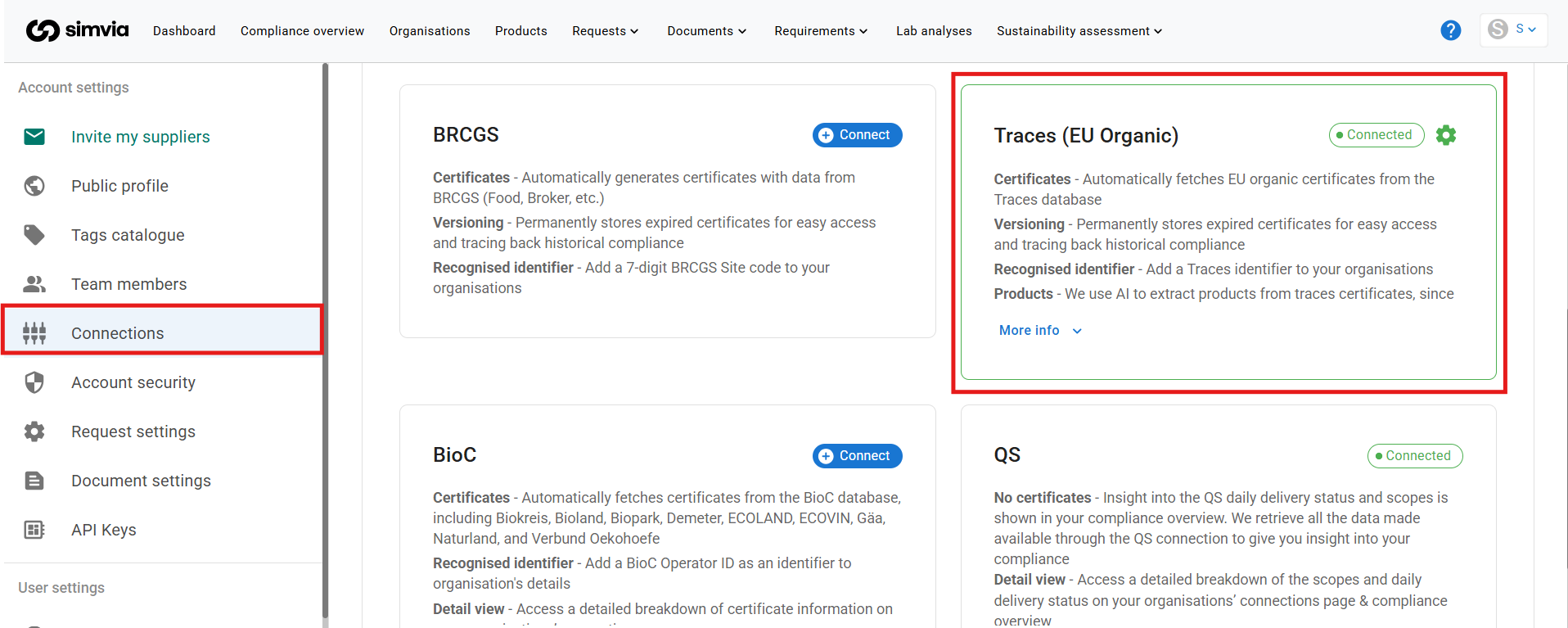
### Part 1 – Connect the TRACES database (one-time setup)
This only needs to be done **once per account**.
1. Go to **Account settings**
2. Open **Connections**
3. Select **TRACES** under databases
4. Click **Connect**
Once activated, the connection remains active for your account.
---
### Part 2 – Add the TRACES reference number to each organisation
To retrieve data, every organisation must have a valid **TRACES reference number** added.
You must add this identifier for:
- All existing organisations you want data for
- All newly created organisations (if applicable)
To add the identifier:
1. Open the organisation in Simvia
2. Go to **Unique identifiers**
3. Enter the **TRACES reference number**
4. Save
This is how the reference appears in the platform:
**BG-BIO-01.XXX-XXXXXXX.2024.03**
Replace the **X’s** with the actual numbers from the certificate.
You only need to enter the **middle numeric part** (the unique operator identifier), not the full formatted string.
**Example**
If the certificate shows:
BG-BIO-01.123-4567890.2024.03
You only need to enter:
123-4567890
Without a TRACES reference number, no data can be retrieved for that organisation.
---
#### 4. Where to find the identifier
The TRACES reference number can typically be found on:
- The organisation’s EU organic certificate
- The organisation’s record in the TRACES database
If needed, you can search directly in TRACES (registration required).
---
#### 5. How data is retrieved
Once:
- The TRACES database is connected, and
- A valid TRACES reference number is added to an organisation
Simvia will automatically retrieve available certificate data.
The TRACES sync runs **daily at 00:00**.
This means new or updated certificate data will be refreshed automatically.
No manual request is required.
---
#### 6. What data is retrieved
When available, Simvia retrieves:
- Operator name
- Certificate valid from date
- Certificate valid to date
- Official document number
This information is stored as a database extract for compliance monitoring.
---
#### 7. How to access and use the data
Retrieved TRACES data can be found in:
- **Documents → Supplier documents** (as a database extract), or
- The organisation’s document overview
You can use this data to:
- Verify organic certification validity
- Monitor expiration dates
- Include organic status in compliance reviews
- Support audit preparation
---
#### 8. Important to know
- Both steps are required:
- Database connection (once per account)
- TRACES identifier per organisation
- You must add the identifier to **every organisation** you want data for
- For new organisations, please remember to add the TRACES reference number if organic certification applies. Once the identifier is added, an additional data fetch should be triggered automatically, so you should not need to wait until 00:00 for the data to become visible.
- Data is refreshed daily at 00:00
- Only certificates available in the official TRACES database can be retrieved
- If no data is returned, verify the reference number and certificate status
The TRACES connection improves organic compliance transparency, but retrieval depends on the accuracy and availability of data within the official EU system.
- [Getting Started](https://helpcenter.simvia.com/knowledge-base/getting-started?hsLang=en#main-content)
- [About Simvia](https://helpcenter.simvia.com/knowledge-base/getting-started?hsLang=en#about-simvia)
- [Navigating the Platform](https://helpcenter.simvia.com/knowledge-base/getting-started?hsLang=en#navigating-the-platform)
- [Account & Access](https://helpcenter.simvia.com/knowledge-base/getting-started?hsLang=en#account-access)
- [Supply Chain Approval (SCA)](https://helpcenter.simvia.com/knowledge-base/supply-chain-approval-sca?hsLang=en#main-content)
- [Dashboard](https://helpcenter.simvia.com/knowledge-base/supply-chain-approval-sca?hsLang=en#dashboard)
- [Compliance Overview](https://helpcenter.simvia.com/knowledge-base/supply-chain-approval-sca?hsLang=en#compliance-overview)
- [Organisations](https://helpcenter.simvia.com/knowledge-base/supply-chain-approval-sca?hsLang=en#organisations)
- [Products](https://helpcenter.simvia.com/knowledge-base/supply-chain-approval-sca?hsLang=en#products)
- [Requests](https://helpcenter.simvia.com/knowledge-base/supply-chain-approval-sca?hsLang=en#requests)
- [Documents](https://helpcenter.simvia.com/knowledge-base/supply-chain-approval-sca?hsLang=en#documents)
- [Requirements](https://helpcenter.simvia.com/knowledge-base/supply-chain-approval-sca?hsLang=en#requirements)
- [PPWR](https://helpcenter.simvia.com/knowledge-base/ppwr?hsLang=en)
- [Sustainability Risk Assessment (SRA)](https://helpcenter.simvia.com/knowledge-base/sustainability-risk-assessment-sra?hsLang=en)
- [Connections](https://helpcenter.simvia.com/knowledge-base/connections?hsLang=en#main-content)
- [Certification Databases](https://helpcenter.simvia.com/knowledge-base/connections?hsLang=en#certification-databases)
- [Laboratory Integrations](https://helpcenter.simvia.com/knowledge-base/connections?hsLang=en#laboratory-integrations)
- [Updates](https://helpcenter.simvia.com/knowledge-base/updates?hsLang=en#main-content)
- [Release Notes 2026](https://helpcenter.simvia.com/knowledge-base/updates?hsLang=en#release-notes-2026)
- [Release Notes 2025](https://helpcenter.simvia.com/knowledge-base/updates?hsLang=en#release-notes-2025)
[](https://www.simvia.com/)
Copyright © 2026, Simvia